General

General

The Strategic Case for e-Waste Recycling: From Waste Management to Resource Security

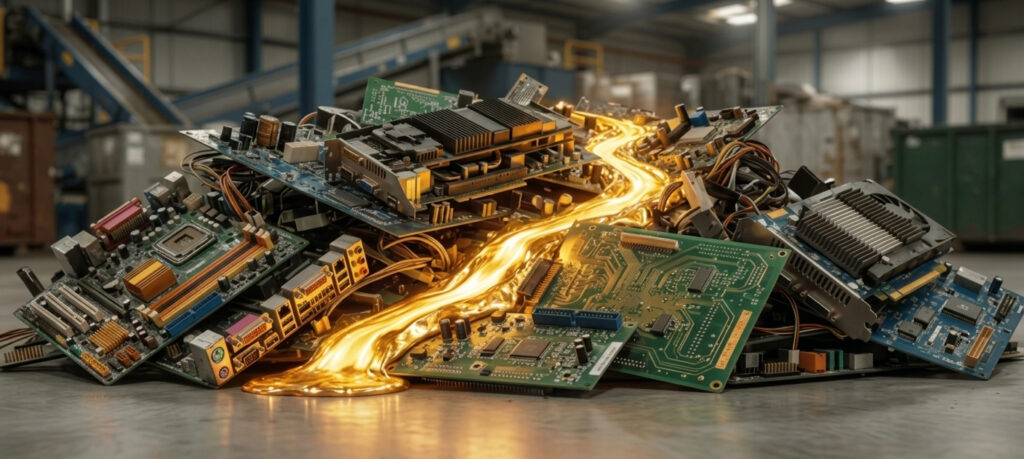
By Venky Murthy | Precious Metal Refining and E-Waste Recovery Consultant What was once viewed primarily as an environmental obligation is rapidly becoming a strategic pillar for resource security, critical minerals supply, and industrial sustainability. Recent market analysis indicates that the global electronic waste recycling market is expected to grow to USD 85  billion by 2030, reflecting the increasing importance of circular economy solutions and responsible resource recovery. Key Strategic Drivers 🔹 Explosive growth in electronics consumption The world continues to generate unprecedented volumes of electronic waste, creating both environmental challenges and significant opportunities for material recovery. 🔹 Critical minerals and precious metals recovery e-Waste represents one of the richest above-ground sources of gold, silver, palladium, copper, lithium, and rare earth elements. Recovering these materials is increasingly important for supply chain resilience and reducing dependence on primary mining. 🔹 Extended Producer Responsibility (EPR) Governments worldwide are strengthening regulations that require manufacturers to take greater responsibility for end-of-life products, accelerating the formalization of recycling ecosystems. 🔹 Circular economy becoming mainstream Leading corporations are embedding circularity into their business models, viewing recycled materials not merely as sustainability initiatives but as strategic resources. Why Asia-Pacific Matters Asia-Pacific is projected to be the fastest-growing e-Waste recycling market globally. Rapid industrialization, expanding electronics manufacturing, urbanization, and stronger regulatory frameworks are creating significant opportunities for investment in collection, recycling, precious metals recovery, and refining infrastructure. Countries that establish advanced recycling and refining capabilities today will be better positioned to secure future supplies of critical raw materials. The Real Opportunity The future of resource security will not be achieved solely through new mines. It will increasingly depend on our ability to build efficient systems that recover valuable materials already circulating within the global economy. e-Waste is no longer a waste problem. It is a resource opportunity, a sustainability imperative, and a strategic economic asset. The nations and companies that invest early in advanced recycling, refining technologies, and circular economy infrastructure will become the leaders of the next industrial era. After more than three decades in the e-waste, precious metals recovery, and refining industry, I remain convinced that the future of resource security lies as much in our discarded electronics as it does beneath the ground.

General

How Businesses Can Recover Gold from E-Waste: A Process, Yield, and Compliance Guide

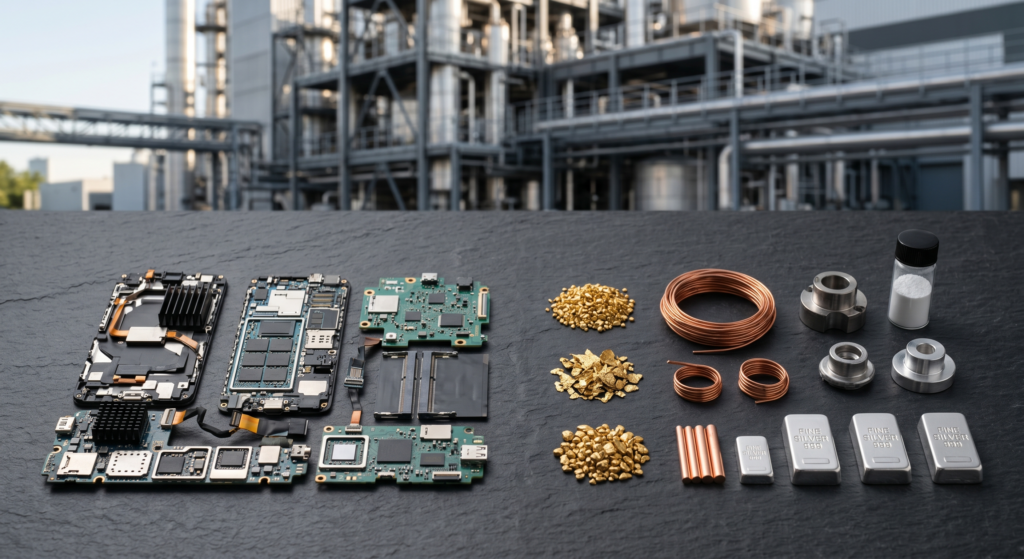
By Venky Murthy | Precious Metal Refining and E-Waste Recovery Consultant A tonne of mined gold ore yields roughly 5 to 10 grams of gold. A tonne of sorted, high-grade circuit boards can yield 300 to 800 grams. That gap is the entire business case for gold recovery from e-waste, and it is why urban mining has grown from a fringe activity into a structured, regulated, and increasingly profitable industry. This guide breaks down exactly how the recovery process works, what different e-waste streams actually yield, what certifications a business needs to operate legally, and where the real margin in this business comes from. Why Gold Recovery from E-Waste Works as a Business Model Gold is used in connectors, circuit board plating, processor pins, and SIM card contacts because it conducts electricity reliably and resists corrosion. That same property makes it recoverable at concentrations far above natural ore. Independent research published in PMC found that the metal content of a printed circuit board is typically ten to a hundred times higher than that of conventionally mined ore, and that recycling one tonne of mobile phones can produce on average 130 kg of copper, 3.5 kg of silver, 0.34 kg of gold, and 0.14 kg of palladium. Other industry analyses go further, noting that select high-grade telecom and server boards can carry up to 800 times the gold concentration of mined ore. For a business evaluating whether to enter this space, that single comparison explains the entire opportunity. The “ore” already exists in collected form. It does not need to be dug out of the ground. It needs to be sorted, processed, and refined correctly. Gold Yield by Device Type: What the Data Actually Shows Yield varies significantly by device age, component grade, and sorting quality. Approximate figures from industry and academic sources: Smartphones: A single modern smartphone contains approximately 0.034 grams of gold. At scale, recycling one tonne of mobile phones yields roughly 140 to 340 grams of gold, depending on device age and model mix. Older phones, including pre-2010 models, often carry heavier gold plating on connectors and SIM slots and can yield more per unit than newer devices. Computers and laptops: A tonne of unsorted computer scrap contains gold in quantities that significantly exceed mined ore. Motherboards alone can yield up to 500 grams of gold per tonne, with additional recovery possible from RAM modules and connectors. High-grade PCB scrap (sorted): Sorted, high-grade circuit boards from servers, telecom equipment, and industrial systems yield the richest returns, in the range of 300 to 800 grams of gold per tonne, with some specialized telecom boards exceeding 1,000 grams per tonne. Legacy electronics: Circuit boards manufactured before 2000 frequently used heavier gold plating standards than modern boards, since miniaturization and cost pressure have reduced gold thickness in newer designs. A 1990s-era computer board can yield 1 to 5 grams of gold individually, far above a modern smartphone’s 0.034 grams. The business implication is direct. Sorting and grading e-waste before processing, rather than treating it as undifferentiated scrap, is what separates a profitable recovery operation from a marginal one. A kilogram of premium telecom boards can carry several hundred dollars of recoverable precious metal value; the same weight of mixed, ungraded e-waste sold in bulk may be worth a small fraction of that. The Four Core Methods Used to Recover Gold from E-Waste Businesses recovering gold from e-waste generally rely on one or a combination of four established methods. 1. Mechanical pre-processing. Before any chemical or thermal extraction begins, e-waste is dismantled, shredded, and sorted using crushers, magnetic separators, eddy current separators, and increasingly, AI-driven optical and X-ray fluorescence (XRF) sorting systems. This step concentrates gold-bearing material (PCBs, connectors, processors) and separates it from plastics, glass, and low-value metal. Skipping or rushing this stage is the single biggest source of value loss in the entire process. 2. Hydrometallurgical leaching. This is the most widely used method for gold recovery from PCBs and is generally regarded as more cost-effective and environmentally controlled than smelting. The process involves chemical leaching, typically using aqua regia or alternative leachants such as thiourea or chloride-based solutions, to dissolve gold from the substrate. This is followed by precipitation or electrowinning to recover pure gold. Hydrometallurgical methods are associated with lower gas and dust emissions and generally higher recovery rates compared to high-temperature alternatives. 3. Pyrometallurgical smelting. One of the oldest extraction methods, pyrometallurgy uses high-temperature smelting to separate gold and other metals from e-waste. It remains effective for processing large, mixed volumes but requires significant energy input and produces emissions that need to be carefully managed under environmental compliance frameworks. 4. Electrochemical refining (electrolysis). Used primarily as a final purification step after hydrometallurgical leaching, electrolysis deposits gold onto a cathode using controlled electrical current, producing high-purity output, often in the range of 99.9% or higher. This step is essential for businesses planning to sell refined gold into investment or industrial markets rather than as unrefined concentrate. Emerging methods, including biotechnological extraction and selective leaching with reduced chemical intensity, are being researched to lower the environmental footprint of the hydrometallurgical step further. For most commercial operations today, hydrometallurgy followed by electrolytic refining remains the standard combination for achieving both high yield and high purity. What a Business Actually Needs Before Starting Gold Recovery Operations Recovering gold from e-waste at commercial scale is a regulated industrial activity, not an informal trade. The certifications and approvals required vary by country, but the structure is broadly consistent. Environmental and pollution control approvals. In India, recyclers must register with the Central Pollution Control Board (CPCB) under the E-Waste Management Rules, 2022, and obtain Consent to Establish (CTE) before construction and Consent to Operate (CTO) before starting operations, both issued by the State Pollution Control Board. Facilities using water-intensive processes such as PCB refining may also require consent from the Central Ground Water Authority. R2 certification. Responsible Recycling (R2), administered through Sustainable Electronics Recycling International and certified by accredited bodies, is the leading

e-waste EPR compliance for recyclers
General

E-Waste EPR Compliance for Recyclers in 2026

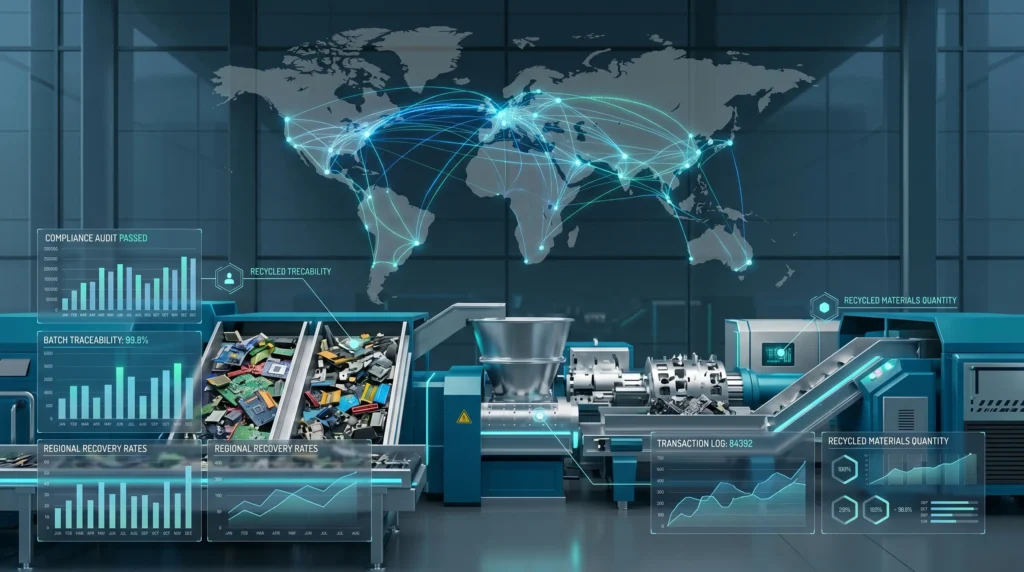
What Every Recycler and Precious Metal Refiner Must Do Right Now By an Industry Practitioner | E-Waste Recycling & Precious Metal Refining | Plant Setup & Compliance Specialist If you operate an e-waste recycling facility or a precious metal refinery — or you are planning to set one up — Extended Producer Responsibility (EPR) compliance is no longer a back-office checkbox. In 2026, it is the single most important operational decision that determines whether you win large OEM contracts, pass international audits, and access the global secondary raw materials market. This guide breaks down exactly what has changed, what regulators are now scrutinising, and the concrete steps your facility needs to take — drawing from real plant-floor experience across India and global markets. $9.2B Global precious metals e-waste recovery market value in 2025 — projected to reach $15.1B by 2035 (CAGR 5.2%) 62 Mt E-waste generated globally in 2023. Only 17.4% was formally recycled — leaving billions in recoverable metals unaccounted. 25 States U.S. states with active electronics EPR legislation as of 2026. Europe and India are tightening frameworks simultaneously. 1. The Shift That Changed Everything: From Paper Certificates to Digital Proof For most of the 2010s, EPR compliance in e-waste was largely a documentation exercise. You collected volumes, filed annual reports, and issued certificates to Original Equipment Manufacturers (OEMs) to satisfy local regulators. The system ran on trust, and more often than not, on approximate numbers. That model is finished. Today, regulators across the EU, India, and the United States are operating cloud-based, interconnected compliance portals that cross-reference tax data, customs records, transport manifests, and physical recycling capacity. A paper certificate or a scanned document does not satisfy these systems. What they require is a traceable, tamper-resistant digital audit trail — from the moment e-waste enters your gate to the point of confirmed metal recovery or certified disposal. FIELD NOTE In one facility audit we observed in western India, the recycler had genuine processing capacity but their documentation was three months behind on batch records. The OEM’s auditor flagged it immediately — not because the recycling was poor, but because the data trail had gaps. The contract was delayed by six months while remediation was completed. The transition is not just regulatory — it is commercial. Global electronics brands are now embedding compliance benchmarks into supplier selection criteria. If your facility cannot demonstrate real-time data readiness, you are simply not on the shortlist. 2. The Four Trends Reshaping EPR in 2026 — Specific to E-Waste and Precious Metal Recovery 2.1 Transaction-Level Traceability — Not Annual Aggregates The most operationally significant change in current EPR frameworks is the shift from annual aggregate reporting to batch-level or unit-level traceability. Every consignment of e-waste entering your facility must now carry a unique digital identifier that links it to: A specific collection point or producer take-back programme A signed transport manifest with vehicle and driver data A receiving record at your facility with timestamp and weight validation A processing batch reference tied to your mass balance ledger Facilities still running on manual gate registers and spreadsheet-based inward records will find it structurally impossible to satisfy this requirement at scale. The documentation problem typically surfaces during audits — not during day-to-day operations — which is why many recyclers underestimate the risk until it is too late. 2.2 Mass Balance Validation — The Maths Must Add Up This is the area where the highest number of compliance failures occur, and also where the most value leaks from a facility. Regulators and OEM auditors are now applying mass balance scrutiny to recycling operations. In simple terms: if you accept 100 tonnes of mixed printed circuit board assemblies (PCBA), they expect to see a reconciled account of where every kilogram went. The inputs must match the outputs plus the residues. If you recover copper, gold, palladium, and other metals — the quantities reported must be consistent with the feed material’s composition and your process’s known efficiency range. Claims that defy the chemistry of your process — whether too high or suspiciously uniform across batches — are immediately flagged. COMMON ERROR A recycler claiming gold recovery rates that are unrealistically high using basic acid-leaching methods. Auditors with metallurgical backgrounds will challenge this instantly. Overstating recovery to look efficient is the fastest way to lose certification. What mass balance validation demands from your operation: Documented input characterisation per batch — material type, estimated composition, source category Process yield records by metal type — copper, gold, silver, palladium, and others Residue and waste stream accounting — slag, epoxy, plastics, hazardous fractions Variance analysis — explaining differences between expected and actual yields 2.3 The Digital Product Passport — Know What Is Coming The EU’s Digital Product Passport (DPP), anchored in the Ecodesign for Sustainable Products Regulation (ESPR), will fundamentally change the information available to recyclers about the products they process. Once fully implemented for electronics, a DPP will contain verified material composition data, disassembly instructions, hazardous substance declarations, and recyclability benchmarks — attached to each product via QR code or RFID. As of 2026, DPP implementation is in its early phase. Batteries are the most advanced sector, with concrete digital requirements being phased in. Electronics-specific mandatory DPPs are still being defined under the ESPR working plan, with delegated acts expected to roll out gradually from 2026 onward. The infrastructure — a central EU DPP registry — is being deployed this year. For recyclers, this matters for two reasons. First, it will soon give you precise, manufacturer-verified data on material content — reducing guesswork in recovery planning. Second, your actual recovery efficiency will be benchmarked directly against the product’s original design specifications. There will be nowhere to hide underperformance. ACTION POINT Start tracking DPP developments through the EU ESPR working plan updates. Build product material characterisation into your intake process now, before it becomes mandatory. Facilities that already maintain composition databases will have a significant head start. 2.4 ESG and Scope 3 Emissions — Your Process Is Now Part of Their

General

Optimizing Refining Yields: Proven Techniques to Maximize Recovery Rates

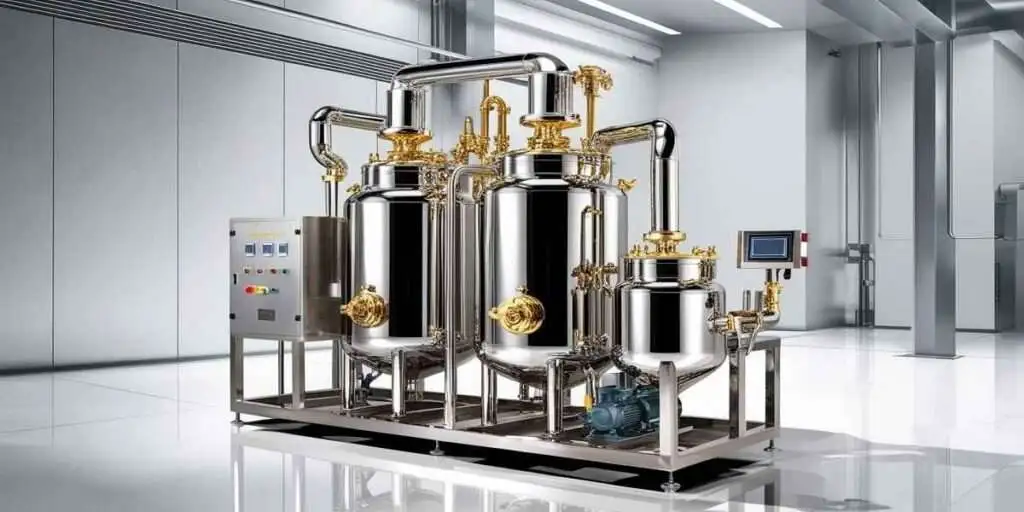
In precious metal refining, yield isn’t just a number—it’s the true measure of efficiency, precision, and profitability. Every fraction of a gram recovered matters. Whether you’re refining from electronic scrap, plating solutions, or industrial residues, optimizing yield directly impacts your bottom line and sustainability goals. Here are some proven techniques and process insights that can help refiners achieve higher recovery rates with better consistency. 1. Start with Accurate Material Characterization Before refining begins, understanding the composition of your feedstock is critical.Techniques like XRF (X-ray fluorescence) and ICP-OES (Inductively Coupled Plasma Optical Emission Spectroscopy) provide precise data on metal content. This allows refiners to design the right chemical process, minimize reagent waste, and prevent losses due to under- or over-treatment. Pro tip: Regular calibration of analytical instruments ensures consistent accuracy in yield calculation 2. Control Reaction Parameters Tightly n chemical refining, small deviations in temperature, pH, or reagent concentration can lead to incomplete reactions or metal losses.Automated monitoring and control systems can maintain stability during leaching, precipitation, and filtration stages, ensuring metals fully transition between chemical states as expected. Key takeaway: Stable process conditions mean predictable and repeatable yields. 3. Optimize Precipitation and Filtration Stages These are often the most critical points for yield loss. Remember: What seems like a minor residue could still hold significant value. 4. Recycle and Reprocess Secondary Streams Every stage of the refining process produces residues, rinses, or filtrates that may contain unrecovered metals.Setting up a secondary recovery loop—to periodically treat these streams—can significantly improve total yield. For instance, refining rinse water or spent acids can often return up to 2–5% additional metal recovery, depending on the material type. 5. Invest in Process Automation and Data Tracking Digitalization is rapidly transforming modern refining.Automated dosing, smart sensors, and real-time analytics reduce human error and improve repeatability. Advanced systems can also track process efficiency over time, identifying yield losses before they become costly. Example: Data-driven process optimization can help achieve up to 10% improvement in overall recovery rates in high-volume operations. 6. Continuous Training and Process Audits Even with the best equipment, process discipline matters. Regular training for operators and periodic process audits ensure standard operating procedures are followed precisely. Small human errors—like incorrect reagent addition or improper washing—can cumulatively affect yields. Final Thoughts Maximizing refining yields is a blend of science, precision, and consistency. The best refiners focus not only on recovery efficiency but also on building systems that learn and improve over time. With accurate analytics, optimized process control, and sustainable recycling loops, refiners can achieve higher yields—turning every ounce of input into measurable value. About the AuthorVenky Murthy is the President & CTO of Advanced United Technology, specializing in advanced hydrochemical refining and recovery of precious metals. With decades of hands-on experience, he focuses on combining science and sustainability to drive innovation in refining.   

Scroll to Top
Enable Notifications OK No thanks