
By Venky Murthy | Precious Metal Refining and E-Waste Recovery Consultant
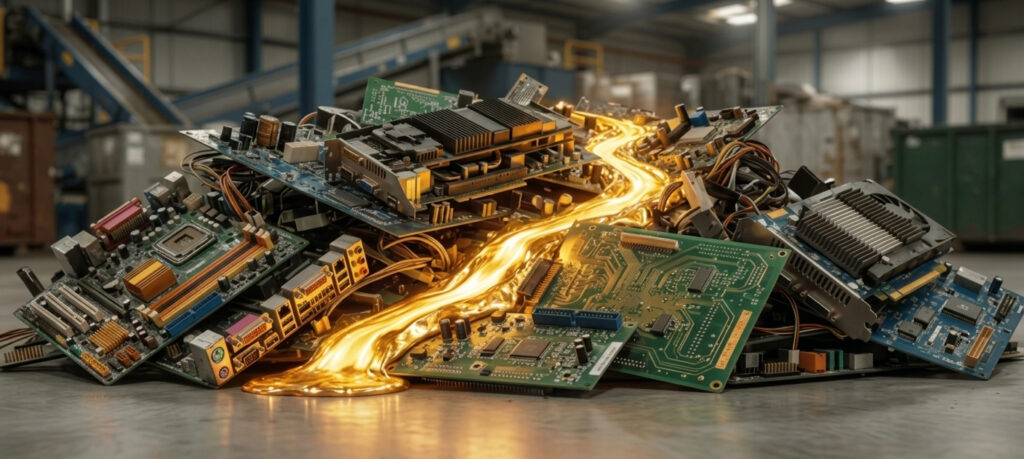
A tonne of mined gold ore yields roughly 5 to 10 grams of gold. A tonne of sorted, high-grade circuit boards can yield 300 to 800 grams. That gap is the entire business case for gold recovery from e-waste, and it is why urban mining has grown from a fringe activity into a structured, regulated, and increasingly profitable industry.
This guide breaks down exactly how the recovery process works, what different e-waste streams actually yield, what certifications a business needs to operate legally, and where the real margin in this business comes from.
Why Gold Recovery from E-Waste Works as a Business Model
Gold is used in connectors, circuit board plating, processor pins, and SIM card contacts because it conducts electricity reliably and resists corrosion. That same property makes it recoverable at concentrations far above natural ore.
Independent research published in PMC found that the metal content of a printed circuit board is typically ten to a hundred times higher than that of conventionally mined ore, and that recycling one tonne of mobile phones can produce on average 130 kg of copper, 3.5 kg of silver, 0.34 kg of gold, and 0.14 kg of palladium. Other industry analyses go further, noting that select high-grade telecom and server boards can carry up to 800 times the gold concentration of mined ore.
For a business evaluating whether to enter this space, that single comparison explains the entire opportunity. The “ore” already exists in collected form. It does not need to be dug out of the ground. It needs to be sorted, processed, and refined correctly.
Gold Yield by Device Type: What the Data Actually Shows
Yield varies significantly by device age, component grade, and sorting quality. Approximate figures from industry and academic sources:
Smartphones: A single modern smartphone contains approximately 0.034 grams of gold. At scale, recycling one tonne of mobile phones yields roughly 140 to 340 grams of gold, depending on device age and model mix. Older phones, including pre-2010 models, often carry heavier gold plating on connectors and SIM slots and can yield more per unit than newer devices.
Computers and laptops: A tonne of unsorted computer scrap contains gold in quantities that significantly exceed mined ore. Motherboards alone can yield up to 500 grams of gold per tonne, with additional recovery possible from RAM modules and connectors.
High-grade PCB scrap (sorted): Sorted, high-grade circuit boards from servers, telecom equipment, and industrial systems yield the richest returns, in the range of 300 to 800 grams of gold per tonne, with some specialized telecom boards exceeding 1,000 grams per tonne.
Legacy electronics: Circuit boards manufactured before 2000 frequently used heavier gold plating standards than modern boards, since miniaturization and cost pressure have reduced gold thickness in newer designs. A 1990s-era computer board can yield 1 to 5 grams of gold individually, far above a modern smartphone’s 0.034 grams.
The business implication is direct. Sorting and grading e-waste before processing, rather than treating it as undifferentiated scrap, is what separates a profitable recovery operation from a marginal one. A kilogram of premium telecom boards can carry several hundred dollars of recoverable precious metal value; the same weight of mixed, ungraded e-waste sold in bulk may be worth a small fraction of that.
The Four Core Methods Used to Recover Gold from E-Waste
Businesses recovering gold from e-waste generally rely on one or a combination of four established methods.
1. Mechanical pre-processing. Before any chemical or thermal extraction begins, e-waste is dismantled, shredded, and sorted using crushers, magnetic separators, eddy current separators, and increasingly, AI-driven optical and X-ray fluorescence (XRF) sorting systems. This step concentrates gold-bearing material (PCBs, connectors, processors) and separates it from plastics, glass, and low-value metal. Skipping or rushing this stage is the single biggest source of value loss in the entire process.
2. Hydrometallurgical leaching. This is the most widely used method for gold recovery from PCBs and is generally regarded as more cost-effective and environmentally controlled than smelting. The process involves chemical leaching, typically using aqua regia or alternative leachants such as thiourea or chloride-based solutions, to dissolve gold from the substrate. This is followed by precipitation or electrowinning to recover pure gold. Hydrometallurgical methods are associated with lower gas and dust emissions and generally higher recovery rates compared to high-temperature alternatives.
3. Pyrometallurgical smelting. One of the oldest extraction methods, pyrometallurgy uses high-temperature smelting to separate gold and other metals from e-waste. It remains effective for processing large, mixed volumes but requires significant energy input and produces emissions that need to be carefully managed under environmental compliance frameworks.
4. Electrochemical refining (electrolysis). Used primarily as a final purification step after hydrometallurgical leaching, electrolysis deposits gold onto a cathode using controlled electrical current, producing high-purity output, often in the range of 99.9% or higher. This step is essential for businesses planning to sell refined gold into investment or industrial markets rather than as unrefined concentrate.
Emerging methods, including biotechnological extraction and selective leaching with reduced chemical intensity, are being researched to lower the environmental footprint of the hydrometallurgical step further. For most commercial operations today, hydrometallurgy followed by electrolytic refining remains the standard combination for achieving both high yield and high purity.
What a Business Actually Needs Before Starting Gold Recovery Operations
Recovering gold from e-waste at commercial scale is a regulated industrial activity, not an informal trade. The certifications and approvals required vary by country, but the structure is broadly consistent.
Environmental and pollution control approvals. In India, recyclers must register with the Central Pollution Control Board (CPCB) under the E-Waste Management Rules, 2022, and obtain Consent to Establish (CTE) before construction and Consent to Operate (CTO) before starting operations, both issued by the State Pollution Control Board. Facilities using water-intensive processes such as PCB refining may also require consent from the Central Ground Water Authority.
R2 certification. Responsible Recycling (R2), administered through Sustainable Electronics Recycling International and certified by accredited bodies, is the leading global standard for electronics recyclers. R2 requires an existing Environmental, Health and Safety Management System, typically ISO 14001, as a foundation, and adds specific requirements around traceability, downstream vendor due diligence, data security, and a ban on exporting hazardous e-waste to countries where it would cause environmental or public health harm.
ISO certifications. ISO 14001 (environmental management), ISO 45001 (occupational health and safety), and ISO 9001 (quality management) are widely recommended, and frequently required by institutional and export buyers, even where not strictly mandated by local law.
Extended Producer Responsibility (EPR) registration. In markets with EPR frameworks, recyclers often register on government EPR portals to receive material directly from obligated producers and brands, creating a more predictable and higher-quality input stream than open-market scrap purchasing.
The investment in proper certification is not just a legal formality. R2 and ISO-certified operations gain access to export markets, institutional clients, and producer EPR contracts that are closed to uncertified recyclers. Certification converts compliance cost into market access.
Where the Real Profit Margin Comes From
For businesses already operating or entering this space, the data points to three consistent profit levers.
Sorting before processing, not after. The difference between a beige circuit board worth a few hundred dollars per kilogram in recoverable gold and an identical-looking board worth a fraction of that is invisible without testing. Businesses using XRF analysis or other rapid elemental screening to grade incoming material before pricing or processing it consistently capture more value than those treating all e-waste as a single commodity stream.
Recovery yield, not throughput. Processing larger volumes of poorly sorted, low-grade material does not generate proportional profit if a significant share of recoverable gold is lost in slag, incomplete leaching, or under-extraction. A smaller, well-sorted, high-grade feedstock processed with disciplined hydrometallurgical control frequently outperforms a larger, unsorted volume on margin per tonne.
Purity at the point of sale. Refined gold sold at 99.9%+ purity through electrolytic refining commands investment-grade and industrial pricing. Unrefined concentrate or partially processed material is sold at a discount to refiners further down the chain, who capture that final margin instead.
The Bigger Opportunity
Global e-waste generation is rising sharply. India alone recorded e-waste volumes climbing more than 72% between 2019-20 and 2023-24, reaching approximately 1.75 million metric tonnes, with a significant share still untreated. Globally, only an estimated 20 to 25% of e-waste is properly recycled today, with the remainder lost to landfill or informal, low-recovery processing.
That gap between generation and proper recovery is the addressable market for businesses that build the right combination of sorting discipline, certified processing capability, and regulatory compliance. The gold is already collected, in the form of discarded phones, computers, and circuit boards sitting in warehouses, storage units, and collection points. What determines whether that gold becomes profit or pollution is the quality of the recovery operation built around it.
Venky Murthy is a global consultant in precious metal refining and e-waste management, advising refineries, recyclers, and governments on facility setup, process optimisation, regulatory compliance, and sustainable recovery systems. To explore how a structured gold recovery operation could work for your business, visit venkymurthy.com or book a consultation.