
Every discarded circuit board, connector, and chip carries a small amount of gold, silver, palladium, or platinum inside it, and across the volume the world discards each year, that adds up to real money. The world generated a record amount of e-waste in the last reporting year, and only a fraction of it was formally collected and recycled, leaving a significant share of that recoverable value unaccounted for. That gap is exactly why precious metal recovery has become a serious industrial activity rather than a niche one.
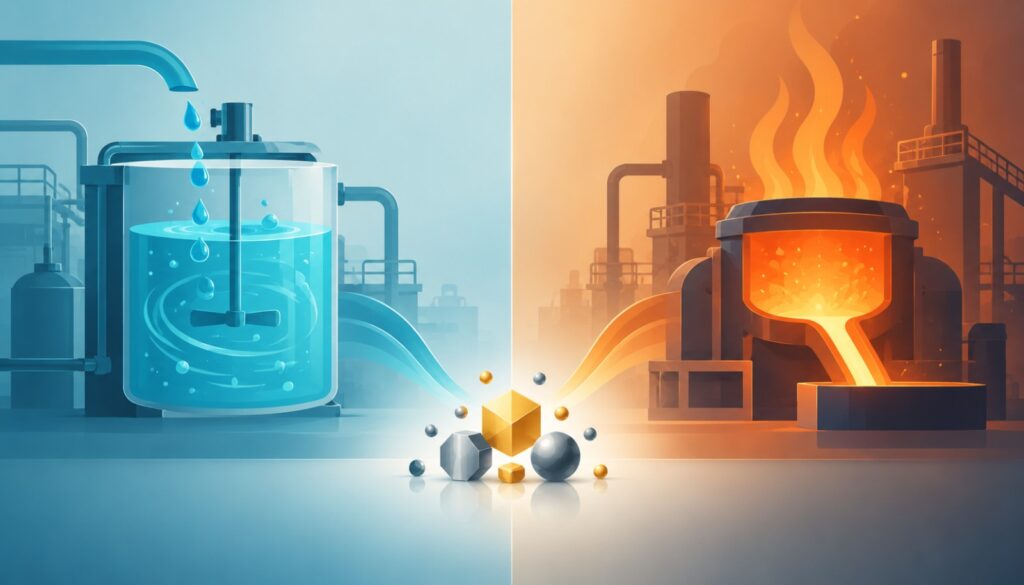
But having valuable metal in a feedstock is only half the story. How that metal is recovered matters just as much as whether it’s recoverable at all. Two process families dominate the industry: hydrometallurgy, which uses chemical and aqueous methods, and pyrometallurgy, which uses high-temperature thermal treatment. Each has a genuinely different set of strengths, and neither is “better” in the abstract, the right one depends entirely on the material in front of you.
This article compares hydrometallurgy vs pyrometallurgy for precious metal recovery in practical terms: how each process works, where each is typically used, how they perform on e-waste specifically, and, critically, when the two are best used together rather than as a choice between one or the other.
What Is Hydrometallurgy?
Hydrometallurgical precious metal recovery uses chemical solutions rather than heat to extract metals from a feedstock. Material is treated with a leaching agent (common options include cyanide, thiosulfate, aqua regia, or halide-based chemistries) that selectively dissolves target metals into solution. The metal-bearing solution is then processed further through techniques like precipitation, ion exchange, solvent extraction, or electrowinning to separate and concentrate the metal of interest.
At a high level, the process runs through three broad stages:
- Leaching, dissolving target metals out of the solid feedstock using a chemical solution
- Separation and purification, isolating the target metal from other dissolved elements and impurities
- Recovery, precipitating, plating, or otherwise converting the purified solution back into solid metal or a refined product
Hydrometallurgy is widely used in precious metal recovery methods for gold and silver leaching from ores and scrap, PGM (platinum group metal) separation from spent catalysts, and selective recovery from complex or low-grade material where a more targeted, chemistry-driven approach is needed.
Key advantages
- High selectivity, can be tuned to target specific metals even in a mixed stream
- Effective on lower-concentration or complex feedstocks where thermal treatment would be inefficient
- Generally lower energy requirements than thermal processes
- Well suited to smaller-scale or modular operations
Key limitations
- Reagent consumption and chemical supply chain can be a significant ongoing operating cost
- Requires careful process control, since leaching efficiency is sensitive to feedstock consistency
- Wastewater and effluent treatment adds compliance and infrastructure requirements
- Chemical handling and worker safety protocols are non-negotiable, especially with cyanide-based systems
What Is Pyrometallurgy?
Pyrometallurgical precious metal recovery uses high-temperature treatment (smelting, roasting, or incineration) to separate metals from a feedstock. Instead of dissolving metals in solution, the process relies on heat to melt, oxidize, or volatilize different components of the material, allowing valuable metals to concentrate into a molten collector phase (often lead, copper, or a similar collector metal) while unwanted material is removed as slag or off-gas.
At a high level, thermal treatment typically follows this sequence:
- Pre-treatment, sizing and preparing the feedstock, sometimes with additives to aid melting or slag formation
- Smelting, high-temperature melting that collects precious metals into a molten metal phase, separated from slag and other waste fractions
- Refining, further treatment of the collected metal phase to isolate and purify the target precious metals
Pyrometallurgy is commonly used for complex, mixed feedstocks, particularly e-waste and PCBs, where the material contains multiple metals, plastics, and coatings that would be difficult to process cleanly through chemical leaching alone. It’s also standard for large-scale, continuous operations processing high volumes of material.
Key advantages
- Handles complex, mixed, and heterogeneous feedstocks effectively
- Generally faster throughput at industrial scale
- Well established, proven technology with a long industrial track record
- Can process material that would foul or complicate a hydrometallurgical circuit
Key limitations
- High energy requirements and associated operating cost
- Significant capital investment in furnace infrastructure and refractories
- Emissions and off-gas treatment require robust control systems to meet environmental standards
- Less selective than hydrometallurgy, often needs a downstream refining step to isolate individual precious metals
Hydrometallurgy vs Pyrometallurgy: Key Differences
Both process families ultimately aim to recover the same metals, but they get there through fundamentally different mechanisms, and that difference shows up in almost every practical decision a plant has to make.
| Factor | Hydrometallurgy | Pyrometallurgy |
| Process type | Chemical / aqueous (leaching, solvent extraction, electrowinning) | Thermal (smelting, roasting, incineration) |
| Energy requirements | Generally lower | Generally high |
| Recovery potential | High, when matched to a compatible feedstock | High, particularly for complex mixed material |
| Selectivity | High, can target specific metals | Lower, often needs downstream refining |
| Feed material suited to | Lower-grade, complex, or chemically variable feeds | Mixed, heterogeneous feeds (e.g. PCBs, e-waste) |
| Processing scale | Suits small to mid-scale, modular setups well | Better economics at large, continuous scale |
| Capital requirements | Moderate | High (furnace infrastructure, refractories) |
| Operating costs | Driven by reagent/chemical consumption | Driven by energy consumption |
| Environmental considerations | Wastewater and effluent treatment | Emissions and off-gas control |
| Waste generated | Spent reagents, treated effluent | Slag, flue dust, off-gas residues |
| Best applications | Selective recovery, PGM separation, lower-volume operations | Complex mixed feedstock, high-volume processing |
Neither route wins outright. Hydrometallurgy tends to win on selectivity and energy efficiency; pyrometallurgy tends to win on throughput and tolerance for messy, mixed feedstock. The right choice is a function of what’s coming through the gate, not a general preference for one technology over the other.
Planning or evaluating a recovery process? Venky Murthy advises businesses on matching the right recovery technology to their specific feedstock and scale. Get in touch to discuss your project →
Hydrometallurgy vs Pyrometallurgy for E-Waste
E-waste is where this comparison gets genuinely interesting, because it’s rarely a clean, single-metal feedstock. A typical printed circuit board carries gold, silver, palladium, copper, and traces of platinum, all bound up together with plastics, ceramics, and solder, which is exactly the kind of complexity that makes hydrometallurgy vs pyrometallurgy for e-waste a real, material-specific decision rather than a theoretical one.
- Gold and silver, both routes recover these effectively; hydrometallurgical leaching is often favored where selective, lower-volume recovery is the priority, while pyrometallurgical smelting is common where PCB volumes are high and the material mix is highly variable.
- Palladium and platinum, typically present in much smaller quantities and often benefit from hydrometallurgical separation techniques (or a hydrometallurgical step following initial thermal concentration) because of how selective the chemistry can be.
- Copper and base metals, usually recovered as a byproduct of either route, often ending up in the collector metal phase in pyrometallurgical processing or handled via separate leaching circuits in hydrometallurgical setups.
- Mixed/complex e-waste streams, where plastics, coatings, and multiple metal types are combined, pyrometallurgical pre-treatment is frequently used to simplify and concentrate the material before a hydrometallurgical step refines it further.
This is one of the clearest illustrations of why precious metal recovery from e-waste so often ends up using both technologies rather than picking one exclusively, a point worth keeping in mind before committing to a single-route plant design.
Gold Recovery from E-Waste: Which Method Works Better?
Gold tends to be the metal that draws the most attention in e-waste projects, since it typically represents the largest share of recoverable value in PCBs and connectors. For gold recovery from e-waste, both approaches are used commercially, and the better fit depends on the operation:
- Hydrometallurgical gold recovery (cyanide, aqua regia, or thiosulfate leaching, followed by precipitation or electrowinning) tends to suit operations that want high selectivity, lower energy costs, and the flexibility to run at a smaller or modular scale.
- Pyrometallurgical gold recovery (smelting the e-waste to concentrate gold into a collector metal phase, refined afterward) tends to suit higher-volume operations processing large, mixed batches of PCB scrap where simplifying the material first makes downstream recovery more manageable.
Rather than a single detailed chemical procedure, the practical takeaway is this: gold recovery performance depends less on which method is “better” in isolation and more on how well the chosen method matches the scale and complexity of the e-waste stream feeding it.
Which Method Is Better for Precious Metal Recovery?
There isn’t a universally better option. The right process depends on how a handful of project-specific variables line up.
Hydrometallurgy tends to make more sense when:
- Feed composition is relatively well characterized and selectivity between metals matters
- Desired metals include PGMs or other elements that benefit from targeted chemical separation
- The operation is running at small to mid-scale, or wants modular capacity that can grow over time
- Energy costs are high relative to reagent costs in the local market
- Capital investment needs to stay moderate rather than committing to large furnace infrastructure
Pyrometallurgy tends to make more sense when:
- Feedstock is highly mixed, heterogeneous, or otherwise difficult to process chemically without extensive pre-treatment
- Recovery targets prioritize overall throughput over metal-by-metal selectivity
- The operation is running at large, continuous industrial scale where thermal economics improve with volume
- Environmental control infrastructure (emissions, off-gas treatment) is already in place or economically justified
- Higher capital investment is acceptable in exchange for proven, high-volume processing capability
In practice, this is exactly the kind of decision where a feedstock-first evaluation, rather than a preference for one technology, determines the right answer. It’s also where independent consulting input tends to add the most value, since the “right” process is rarely obvious from equipment brochures alone.
Can Hydrometallurgy and Pyrometallurgy Be Used Together?
Yes. In industrial-scale precious metal recovery, this is often the norm rather than the exception.
Integrated pyro-hydrometallurgical flowsheets are widely used precisely because the two technologies are complementary rather than competing. A typical combined approach looks like this:
Mixed feedstock → Pyrometallurgical pre-treatment (concentration into a collector metal phase) → Hydrometallurgical refining (selective leaching and separation) → Final refined product
The thermal stage does what it does best: handling complex, mixed, high-volume material and concentrating precious metals into a manageable intermediate product. The chemical stage then does what it does best: selectively separating and purifying individual metals from that concentrate with high precision.
This combined approach is often the strongest option for operations dealing with genuinely complex feedstocks like mixed e-waste, because it plays to the strengths of both technologies instead of asking a single process to do everything. Framing the decision as hydrometallurgy versus pyrometallurgy is useful for understanding the trade-offs, but framing it as hydrometallurgy and pyrometallurgy is often closer to how the best-performing plants are actually designed.
Considering an integrated recovery flowsheet? Combining thermal and chemical processing correctly takes careful sequencing and feedstock planning. Speak with Venky Murthy about designing the right process flow →
Choosing the Right Precious Metal Recovery Process
Rather than starting with a technology preference, work through the decision in this order:
Feed characterization → Metal composition and target metals → Required recovery and selectivity → Production scale → Economics and capital investment → Environmental and regulatory requirements → Process selection
A few practical notes on applying this framework:
- Don’t select a process before you’ve properly characterized the feedstock. This is the most common and most costly mistake in recovery plant planning.
- Model economics on realistic throughput and yield assumptions, not best-case vendor claims.
- Consider whether an integrated flowsheet (pyro followed by hydro) might outperform a single-technology approach for your specific material mix.
- Factor in environmental compliance requirements early, since they materially affect both technology suitability and capital cost.
This turns the hydrometallurgy-versus-pyrometallurgy question into something genuinely useful for a business evaluating a real project, rather than a purely academic comparison.
Frequently Asked Questions
Is hydrometallurgy or pyrometallurgy better for precious metal recycling? Neither is universally better. Hydrometallurgy generally offers higher selectivity and lower energy costs, while pyrometallurgy handles complex, mixed feedstocks and high volumes more efficiently. The better fit depends on your specific feedstock, scale, and recovery targets.
Which method is more common in precious metal recycling for e-waste? Both are used, often together. Pyrometallurgical pre-treatment is common for simplifying mixed e-waste streams, followed by hydrometallurgical refining to selectively recover individual precious metals.
Is hydrometallurgy more environmentally friendly than pyrometallurgy? Both processes carry environmental considerations that need active management. Hydrometallurgy generates wastewater and spent reagents requiring treatment, while pyrometallurgy generates emissions and off-gas requiring control systems. Neither is inherently “clean” without proper environmental infrastructure in place.
Can a small-scale operation use pyrometallurgy? Pyrometallurgy generally has stronger economics at larger, continuous scale due to its capital and energy intensity. Smaller or modular operations more often lean toward hydrometallurgical routes, though this depends on the specific feedstock and business case.
Conclusion
There is no single best recovery method between hydrometallurgy and pyrometallurgy. The right choice depends on the feedstock, target metals, recovery objectives, economics, scale, and environmental requirements of the specific operation, and, very often, the best answer combines both technologies rather than choosing one.
If you’re evaluating or upgrading a precious metal recovery operation, the right process selection can have a major impact on recovery performance, operating costs, and overall plant efficiency over the life of the facility.
References
- UN Institute for Training and Research (UNITAR) & International Telecommunication Union (ITU), Global E-waste Monitor 2024
- World Gold Council, industry data on gold demand and recycling
Speak With Venky Murthy About Your Refining or Recovery Project
Whether you’re weighing hydrometallurgy against pyrometallurgy, considering an integrated flowsheet, or planning a new recovery facility from scratch, getting the process selection right early can shape your plant’s performance for years to come.