
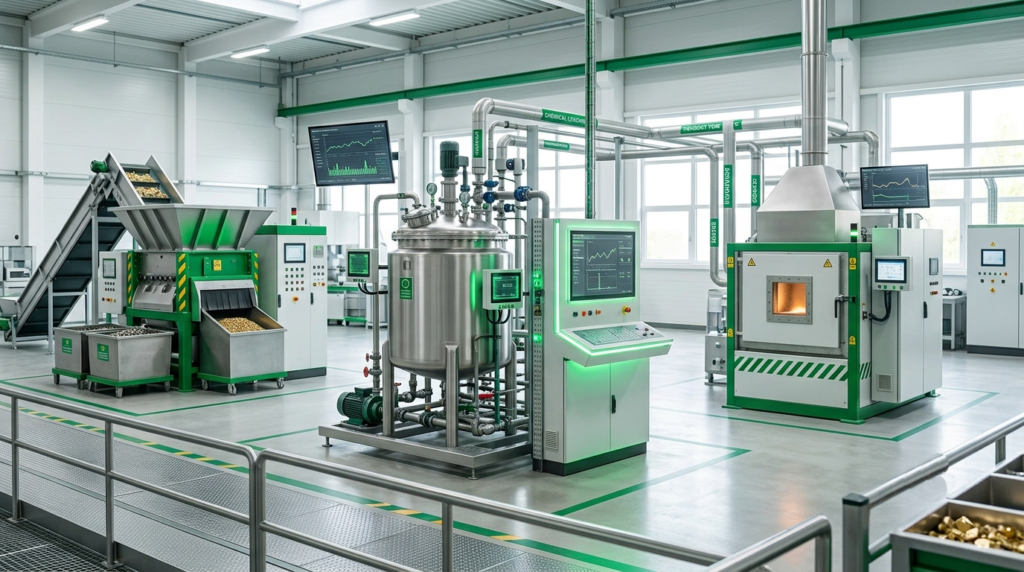
Every year, companies invest significant capital in precious metal recovery projects. Many spend months comparing equipment and recovery technologies, yet overlook the most important question:
Is this technology actually suitable for the material they plan to process?
In practice, technology selection is rarely the reason a project succeeds or fails on its own. Feedstock quality, recovery economics, process compatibility, and long-term operational planning usually have a much bigger impact than the brand or sophistication of the equipment on the floor.
This guide walks through a practical framework for evaluating precious metal recovery plant technology — the process routes available, the factors that actually drive project success, and the mistakes that quietly sink otherwise well-funded recovery plants.
Why Technology Selection Rarely Decides a Project on Its Own
Most feasibility discussions focus heavily on equipment specifications — throughput, footprint, automation level, advertised recovery percentage. Far fewer spend equivalent time on the variables that actually determine whether that equipment performs once real, inconsistent material starts arriving at the gate:
- Feedstock variability — the same “PCB scrap” line item can carry meaningfully different metal content between suppliers or even between batches from the same supplier
- Process-material compatibility — a process tuned for one impurity profile can lose significant recoverable value when that profile shifts
- Recovery losses — small inefficiencies compound over time; a process that looks slightly less efficient on paper can still be the more profitable choice once reagent and energy costs are counted
- Waste and effluent handling — some high-recovery processes generate waste streams that are expensive or legally complex to manage
- Operating cost stability — reagent-heavy processes are exposed to commodity price swings in a way mechanical processes generally aren’t
A technically advanced system does not automatically guarantee a successful operation. The best precious metal recovery plant setup isn’t the most expensive or most sophisticated one — it’s the one that consistently recovers value from your material, under your operating conditions, over many years of use, not just during a vendor demonstration.
Start With Feedstock Analysis, Not Equipment Catalogs
The single most important principle in recovery plant design: technology should follow the material, not the other way around.
One of the most common challenges in this industry is that companies design a plant around the feedstock they expect to receive — and then the actual material shifts over time as suppliers, sourcing regions, or device types change. Unless the process has enough flexibility built in from the start, recovery performance and operating costs can be affected well after the plant is already running.
Precious metal recovery feedstocks differ enormously in composition and behavior:
| Feedstock type | Typical primary metals | Relative complexity |
| Printed circuit boards (PCBs) | Gold, silver, copper, palladium | High — mixed substrates, plastics, coatings |
| Spent auto/industrial catalysts | Platinum, palladium, rhodium | High — low concentration, ceramic/metal substrate |
| Jewellery and bullion scrap | Gold, silver, platinum | Low-moderate — generally cleaner, known alloy ratios |
| Mixed e-waste (mobile phones, connectors, memory chips) | Gold, silver, palladium, copper | Very high — highly heterogeneous batch-to-batch |
| Industrial residues / anode slime | Silver, gold, selenium, tellurium | Moderate-high — process-dependent, often already partially concentrated |
Before any process route is selected, a proper feedstock analysis needs to answer:
- What metals are present, and in what concentration range?
- How consistent is the material supply, batch to batch and season to season?
- What impurities, plastics, or coatings will interfere with recovery?
- What is the realistic, sustainable feed volume — not the best-case volume?
- What form does the final product need to take (doré bars, refined bullion, precipitate for onward refining)?
Skipping this step means technology gets chosen based on assumptions rather than real operating data — and it’s the single most common root cause of underperforming recovery plants.
The Main Precious Metal Recovery Process Routes
There is no universal solution. Commercial operations typically combine two or more of the following process families depending on feedstock and recovery objectives.
1. Mechanical Processing and Material Preparation
Almost every recovery system starts here. Mechanical processing — shredding, sizing, magnetic and eddy-current separation, density-based sorting — prepares material for downstream recovery by improving liberation and concentrating the valuable fraction before more expensive chemical or thermal steps are applied. For complex materials like e-waste, the quality of this preparation stage disproportionately affects everything that happens downstream.
2. Pyrometallurgical Recovery
Pyrometallurgical routes use high-temperature smelting or incineration to recover metals, and are often well-suited to complex, mixed feedstocks where thermal treatment simplifies separation. The trade-offs worth evaluating:
- Higher capital investment (furnace infrastructure, refractories)
- Significant energy requirements
- Emission control systems required for compliance
- Generally better suited to larger, continuous-scale operations
3. Hydrometallurgical Recovery
Hydrometallurgical processes use chemical leaching and solution-based separation (cyanidation, thiosulfate leaching, aqua regia, ion exchange, electrowinning) to selectively extract metals. This route often suits operations targeting flexibility across varying feedstocks, but requires careful attention to:
- Chemical/reagent consumption and supply chain
- Process control and consistency
- Wastewater and effluent treatment
- Worker safety and chemical handling protocols
4. Electrochemical Refining
Electrolytic refining (for example, the Wohlwill process for gold or the Moebius process for silver) typically comes in as the final purification stage rather than a standalone recovery route — it takes a doré or concentrate and brings it to high-purity product. Capital cost is moderate, but the process demands precise electrical and chemical control.
5. Integrated Systems
Most successful facilities don’t rely on a single technology — they combine routes into a staged system:
Feed preparation → Concentration → Metal recovery (pyro or hydro) → Refining/electrolysis → Final product
In practice, the goal isn’t to squeeze out the highest possible recovery at any one stage. It’s to build a process where each stage works efficiently and feeds a cleaner, more concentrated stream to the next — so the overall operation is profitable, not just impressive on paper at one step.
Technology Alone Will Not Keep a Plant Running
This is the part that’s easy to miss in a technology comparison: even the best-chosen process can’t compensate for problems that sit outside the plant itself. A recovery operation depends just as much on:
- Consistent feedstock supply — a plant sized and tuned for a certain volume and grade of material will struggle if that supply becomes unpredictable
- Reliable reverse logistics — collection, sorting, and transport arrangements that keep material flowing in on schedule
- Supplier relationships you can depend on — one-off scrap purchases behave very differently from a stable sourcing network built over time
A plant with excellent technology but weak feedstock security tends to underperform its own capability. Conversely, a well-secured feedstock pipeline paired with a reasonably good (not perfect) process often outperforms the reverse. Technology selection and supply strategy need to be planned together, not treated as separate conversations.
Key Factors When Choosing Precious Metal Recovery Plant Technology
1. Feedstock Availability and Quality
A plant is only as good as its guaranteed supply. Evaluate feedstock availability, consistency, and how it might shift over the next several years — a plant over-engineered for today’s material mix can struggle if sourcing changes.
2. Target Metals and Recovery Goals
Are you optimizing for gold, silver, PGMs, copper, or a multi-metal recovery strategy? The answer should align both the feedstock available and the market opportunity you’re pursuing — chasing every metal in the stream is rarely the most profitable strategy.
3. Recovery Economics and Return on Investment
This is where most technology comparisons go wrong. A high theoretical recovery percentage means little without accounting for:
- Processing cost per unit of feedstock
- Energy and reagent consumption
- Waste handling and disposal cost
- Final product value net of refining and transport
- Payback period and capital efficiency across the plant’s operating life
Metal recovery economics should always be modeled on realistic, not best-case, throughput and yield assumptions — the difference between the two is often where a project’s actual return on investment lives.
4. Scale, Scalability, and Production Requirements
Technology validated at pilot or lab scale doesn’t always translate linearly to commercial scale. Plant scale drives equipment selection, automation level, staffing, and capital structure. It’s worth designing for operational flexibility as well — the ability to scale up, or adjust to a changing feedstock mix, without a full technology overhaul — rather than building strictly to today’s contracted volumes.
5. Testing and Analytical Capability
A reliable in-house or contracted assay/testing capability is not optional. Without accurate sampling and analysis, operators can’t verify incoming material value, monitor process performance, or catch recovery losses before they compound into real financial losses.
6. Regulatory and Environmental Compliance
Precious metal recovery — particularly e-waste metal recovery — sits inside an increasingly strict regulatory environment (extended producer responsibility obligations, hazardous waste handling, effluent and emissions limits). Technology choice has to account for the compliance burden it creates, not just the recovery performance it promises.
Common Mistakes in Precious Metal Recovery Technology Selection
- Choosing equipment before feedstock analysis — the most common and most expensive mistake in the sector.
- Optimizing for recovery percentage alone — a process with modestly lower recovery but meaningfully better economics is often the better business decision.
- Ignoring feedstock variability — real-world material is rarely as consistent as the sample used during a vendor demonstration.
- Underinvesting in laboratory/testing capability — treated as a one-time pre-launch cost rather than an ongoing operational requirement.
- Skipping pilot-scale validation — moving straight from vendor claims to full commercial scale without validating performance on your actual material.
- Underestimating reagent and consumables logistics — hydrometallurgical routes especially carry supply chain and chemical-handling costs that are easy to overlook at the planning stage.
- Treating feedstock security as someone else’s problem — technology decisions made without a parallel sourcing and logistics strategy tend to underperform regardless of how well the process itself is chosen.
A Practical Decision Framework
Before committing to any precious metal recovery plant setup, work through this sequence rather than starting from a vendor shortlist:
- Characterize the feedstock (composition, concentration range, variability, supply consistency)
- Define target metals and realistic recovery goals
- Shortlist process routes compatible with that feedstock — not the other way around
- Model recovery economics and return on investment under realistic, not best-case, assumptions
- Validate at pilot scale wherever possible before full commercial investment
- Confirm environmental and regulatory compliance pathways for the shortlisted process
- Build in analytical/testing capability and a feedstock security plan from day one
Frequently Asked Questions Before Selecting Recovery Technology
How do I know which recovery technology is suitable for my material? Start with feedstock analysis, not a vendor comparison. Understanding what metals are present, at what concentration, how consistent the supply is, and what impurities are involved will narrow the suitable process routes far more reliably than comparing recovery percentages alone.
What should I evaluate before investing in a recovery plant? At minimum: feedstock composition and consistency, target metals, realistic recovery economics and return on investment, waste and effluent handling requirements, production scale and scalability, and the regulatory compliance pathway for your chosen process.
Should I choose a hydrometallurgical or pyrometallurgical process? Both are used commercially, often in combination. Pyrometallurgical routes tend to suit complex, mixed, higher-volume feedstocks, while hydrometallurgical routes offer more selective recovery but bring higher reagent, safety, and effluent-management requirements. The right answer depends on your specific feedstock and project scale — not a general preference for one over the other.
Why is feedstock testing important before selecting technology? Because process performance is only as reliable as the material it’s designed around. Skipping proper feedstock testing means technology gets chosen based on assumptions rather than real operating conditions, which is the most common cause of underperforming recovery plants.
Should I test the process before investing in a commercial plant? Wherever feasible, yes. Vendor demonstrations are typically run on ideal sample material. Pilot-scale testing on your own feedstock is the most reliable way to validate real-world recovery rates and economics before committing full capital.
How a Precious Metal Recovery Consultant Reduces Project Risk
Technology selection is one of the highest-stakes decisions in any recovery plant project, and it’s exactly the point where independent, feedstock-first technical guidance pays for itself many times over. A precious metal recovery consultant helps evaluate:
- Suitable process options for your specific feedstock
- Feedstock-technology compatibility and realistic recovery expectations
- Technology limitations and hidden operating costs
- Project feasibility, capital efficiency, and phased investment planning
- Regulatory and environmental compliance pathways
- Feedstock security and sourcing strategy alongside the technology decision
The goal is never to recommend the most sophisticated available technology — it’s to build a recovery strategy that matches your material, your investment objectives, and your long-term business plan.
Conclusion
Choosing the right precious metal recovery plant technology requires a complete understanding of materials, processes, and economics — not a comparison of machine specifications in isolation. Successful recovery operations are built by connecting the right feedstock, the right process route, the right technology, and the right business model, in that order.
Before investing in equipment or plant infrastructure, evaluate honestly whether the selected technology can deliver reliable, sustainable recovery performance under real, not best-case, operating conditions. A well-planned technology strategy, grounded in proper feedstock analysis and a secure supply pipeline, is the single biggest lever for reducing project risk and improving long-term operational success.
References
- UN Institute for Training and Research (UNITAR) & International Telecommunication Union (ITU), Global E-waste Monitor 2024
- World Gold Council, industry data on gold demand and recycling
- International Energy Agency (IEA), reporting on critical minerals and recycling
Planning a Precious Metal Recovery Project?
Whether you’re evaluating a new recovery plant, expanding an existing operation, or selecting the right recovery technology, making the right technical decisions early can reduce project risk and improve long-term performance.
Book a consultation to discuss your project.