
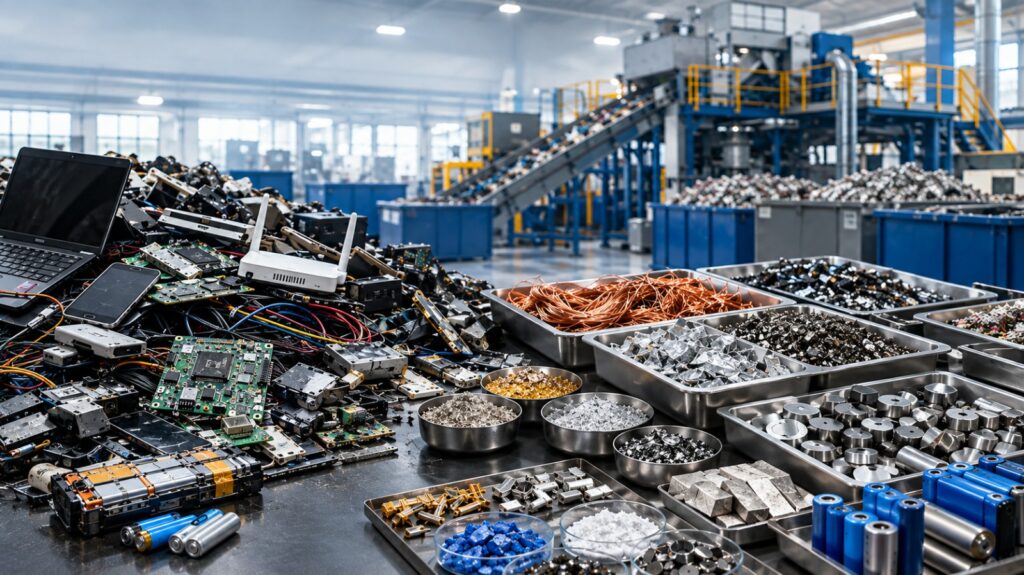
E-waste is not simply discarded electronics. It is a complex secondary resource containing precious metals, base metals and a range of other recoverable materials, from copper and aluminium to lithium, cobalt and rare earth elements.
But the presence of a valuable material does not automatically mean it can be recovered economically. What matters just as much as what’s inside e-waste is how concentrated it is, how it’s mixed with other materials, and whether a viable process exists to recover it at a given scale.
This article examines which materials can genuinely be found in e-waste, where they typically occur, how they’re recovered at scale, and what determines whether that recovery makes commercial sense.
What Materials Can Be Recovered from E-Waste?
Electronic waste can contain several broad categories of recoverable material, though not every category appears in every product.
Precious metals are present in small but valuable quantities in many electronic components. Gold, silver, palladium and platinum are the most commonly discussed, largely because of their use in connectors, contacts and circuit boards.
Base metals typically occur in much larger volumes. Copper, aluminium, iron and nickel are found across cables, frames, circuit boards and structural components, and they often represent a significant share of a recovery operation’s overall economics.
Other critical and valuable materials appear depending on the type of electronic product. Lithium, cobalt, rare earth elements and other specialty metals are found mainly in batteries, magnets and specific electronic components, not across e-waste generally.
Other recoverable materials round out the picture. Plastics, glass and other secondary materials can also be recovered from casings, displays and packaging, even though they carry far less value per unit than metals.
It’s worth being clear on one point early: not every type of e-waste contains every material listed above. Composition varies significantly by product type, age, design and the specific components involved. A discarded router and a discarded laptop battery pack are both “e-waste,” but their material profiles have almost nothing in common.
Precious Metals in E-Waste
Precious metals are used in electronics because of properties that base metals can’t easily replicate: excellent electrical conductivity, strong corrosion resistance and long-term reliability in components that need to keep working for years without degrading. That’s precisely why certain e-waste streams, particularly those rich in circuit boards and connectors, are considered valuable feedstocks for recovery operations.
Gold
Gold is used in electronics for its conductivity and resistance to corrosion and tarnishing, which makes it well suited to connectors, contacts, and plated components on circuit boards where a reliable, long-lasting electrical connection matters. It’s typically found in connectors, contacts, circuit boards, and select high-reliability components, though the amount present varies considerably depending on the device and its age.
Gold recovery is commercially important because, even at low concentrations per unit of e-waste, the cumulative value across large volumes of feedstock can be substantial. That said, concentration and recovery efficiency matter enormously here. Contained gold and recovered gold are not the same thing, and the process used to extract it has a direct impact on how much of that value is actually realised.
We’ve covered the detailed process, yields, and compliance considerations involved in gold recovery separately. For a deeper look at how this works in practice, see
How Businesses Can Recover Gold from E-Waste: A Process, Yield, and Compliance Guide.
Silver
Silver is used in electronics for similar reasons to gold: strong conductivity and reliable performance in contacts, switches and certain circuit board applications. It occurs across a wider range of components than gold, though generally in lower unit value.
Because silver is used more broadly but at lower value per unit, its recovery depends heavily on feed composition and process economics. A feedstock with meaningful concentrations of silver-bearing components can make a real difference to overall recovery value, but it rarely justifies a recovery process on its own.
Palladium
Palladium plays an important role in certain electronic components, particularly multilayer ceramic capacitors and select connector types, where its properties support reliable performance in compact components. It occurs in specific parts of circuit boards and components rather than throughout a device.
Its relevance to precious metal recovery comes down to concentration and recovery efficiency. Palladium is genuinely valuable where present, but without proper characterisation of the feedstock, it’s easy to overestimate or underestimate how much is actually recoverable from a given batch.
Platinum
Platinum can occur in certain e-waste streams, though its presence is far less consistent than gold, silver or palladium. Where it does appear, it tends to be valuable, but its presence depends heavily on the specific type of electronic waste involved, not a general feature of e-waste as a category.
Platinum shouldn’t be treated as equivalent in importance to gold or copper across e-waste broadly. It’s a genuine part of the picture in some feedstocks, and largely absent in others.
Base Metals Recovered from E-Waste
Precious metals get most of the attention, but the value of e-waste isn’t limited to them. Base metals often occur in much larger quantities, and they can be an important part of overall recovery economics, sometimes more important than the precious metal content, depending on the feedstock.
Copper
Copper deserves the most attention in this category, both because of the quantities involved and its consistent value. It’s found extensively in circuit boards, cables and wiring, and various electrical components across almost every category of electronic product.
Copper recovery matters for two reasons at once: it’s present in significant volume across most e-waste streams, and it holds steady commercial value. In many recovery operations, copper contributes meaningfully to overall economics alongside, not instead of, precious metal recovery.
Aluminium
Aluminium is used in electronics for structural components, casings and certain internal parts where its light weight and reasonable conductivity are useful. It can be recovered from these components as part of broader material separation processes, and it functions as a genuinely recyclable material within e-waste streams rather than a byproduct.
Iron
Iron typically appears in frames, structural components and other metal parts that provide mechanical support rather than electrical function. Its recovery is usually part of broader ferrous separation processes rather than a dedicated recovery stream.
Nickel
Nickel is used across various electronic applications and is also relevant to certain battery chemistries. Its presence and recoverable quantity vary considerably depending on the specific product and, where batteries are involved, the battery chemistry in use. Nickel in a battery pack behaves very differently, in terms of recovery process and economics, from nickel in a structural component.
Other Valuable Materials in E-Waste
E-waste isn’t simply a source of gold, or even of precious and base metals generally. Certain streams also contain lithium, cobalt, rare earth elements and other critical materials, though which of these are present depends heavily on the type of electronic product.
Battery-containing equipment is a good example of why this distinction matters. A feedstock dominated by lithium-ion batteries has a fundamentally different material profile, and requires a different recovery approach, than a feedstock dominated by circuit boards. Treating the two as equivalent oversimplifies both the opportunity and the process required.
Plastics and glass are also part of the picture, found in casings, displays and other components. They carry far less value per unit than metals, but they’re part of what makes e-waste a genuinely multi-material secondary resource rather than simply a delivery mechanism for gold.
Where Are These Valuable Materials Found?
It helps to think about this at the component level rather than the device level, since that’s where material composition actually varies.
Printed circuit boards may contain copper, gold, silver, palladium and other metals, depending on the specific components and board type involved. PCBs are often the most material-diverse part of an electronic device.
Cables and wiring are primarily a copper and aluminium source, with the exact mix depending on the application and cable type.
Connectors and contacts may carry gold, silver and other conductive materials, particularly in components designed for reliability or high-frequency signal integrity.
Batteries contain materials that vary by chemistry, including lithium, cobalt, nickel and other materials depending on the battery type in question.
Displays and casings may contain glass, plastics, metals and other materials depending on the product type, with significant variation between, for example, a smartphone screen and an appliance casing.
One important writing point carries through all of this: these are patterns, not universal rules. A component “may contain” a given material, and the actual composition varies by product type. Treating any of these associations as guaranteed, rather than typical, leads to unreliable feedstock assumptions.
How Are Metals Recovered from E-Waste?
At a high level, the recovery pathway looks like this: collection, sorting, dismantling, size reduction, separation, metal recovery, and refining.
The actual process used at each stage depends on feed composition, the target metals, their concentration, the scale of the operation, the purity required in the final product, and the underlying economics of the whole operation.
Mechanical Pre-Processing
Before any chemical or thermal recovery takes place, e-waste typically goes through dismantling, sorting, size reduction and initial concentration or separation. This stage doesn’t recover metal directly. It prepares the feedstock so that later recovery stages are working with a more concentrated, more consistent material, which makes everything downstream more effective.
Hydrometallurgical Recovery
Hydrometallurgical recovery uses chemical leaching to dissolve target metals out of the material, followed by selective separation, recovery and refining to isolate and purify the metal of interest. It’s a chemistry-driven approach that tends to offer strong selectivity, particularly useful when a feedstock needs specific metals separated out with precision.
Pyrometallurgical Recovery
Pyrometallurgical recovery uses thermal processing to concentrate and separate metals, and it’s often useful for complex, mixed feedstocks where chemical processing alone would be inefficient. Process control and emissions control are important parts of running this kind of operation responsibly.
We’ve covered the trade-offs between these two approaches, and where they’re often used together, in more depth elsewhere. See hydrometallurgical and pyrometallurgical recovery methods for a detailed comparison.
What Determines the Value of E-Waste?
This is where the picture moves beyond a simple materials list. The presence of valuable metals is only the starting point. What actually determines value is a combination of several factors working together.
Feed composition varies considerably between electronic products, and that variation is the foundation every other factor builds on.
Material concentration affects recovery economics directly. A material present in trace amounts behaves very differently, economically, from the same material present in meaningful concentration.
Assay and characterisation are essential before any recovery or processing decision gets made. Understanding what’s actually present in a given feedstock, rather than assuming based on general product category, is what separates a sound recovery plan from a speculative one.
Recovery efficiency matters because contained metal is not necessarily recovered metal. A process that captures 60% of the available value performs very differently, financially, from one that captures 90%, even on identical feedstock.
Process selection has to suit both the feedstock and the target materials. The right process for PCB-heavy material is not automatically the right process for battery-heavy material.
Scale changes the economics significantly. What’s viable at industrial scale may not be viable for a smaller operation, and vice versa depending on the process chosen.
Processing and refining costs matter because converting recovered material into a usable, refined product isn’t free. That cost has to be weighed against the value being recovered.
Market conditions affect the economics of recovery in real time, since metal prices move and recovery economics move with them.
Compliance and operating requirements are part of the overall economics too, not a separate consideration. Environmental, safety and regulatory requirements shape what a recovery operation can do and what it costs to do it.
Evaluating the recovery potential of your e-waste feedstock? Understanding material composition, recovery yields and process economics is an important first step. Discuss your recovery project with Venky Murthy →
Why Recovery Efficiency Matters
This is one of the more important ideas in this article: material contained is not the same as material recovered.
The realistic progression looks like this: material contained, then material recovered, then material refined, then value realised. Each step loses something, and how much gets lost at each stage has a direct effect on the final outcome.
Recovery yield, processing losses, selectivity, process conditions, refining efficiency, and energy and chemical requirements all affect how much of the contained value actually becomes realised value. Two operations processing identical feedstock can end up with very different financial outcomes purely based on how efficiently each stage of the process is run, and what it costs to run it.
This is the point that separates a genuinely useful recovery strategy from simply identifying valuable metals in a waste stream. Knowing gold is present tells you very little on its own. What matters is how much of it you can actually recover, refine and turn into value, after accounting for the real costs involved. This is also where process optimisation tends to make the biggest measurable difference to an operation’s returns.
Looking beyond metal content? Recovery economics depend on more than the amount of metal present. Process selection, recovery efficiency and operating conditions all influence the value that can ultimately be realised. Explore your recovery options with Venky Murthy →
E-Waste as a Secondary Resource
E-waste contains materials that have already entered the economic system once. Recovery is what turns discarded products back into usable secondary raw materials, rather than letting that value sit unrecovered in landfill or storage.
Precious metals are only one part of this opportunity. Base metals and other critical materials contribute meaningfully to overall resource recovery, and in many feedstocks, they represent a larger share of total recoverable value than precious metals alone.
Realising that value consistently requires the right combination of feedstock knowledge, suitable processing technology, strong recovery efficiency, and reliable refining, working together rather than any one of them in isolation. This is essentially what urban mining is about: treating existing electronic products as a resource base rather than only as waste to be managed.
For a broader look at why this matters at an industry and resource-security level, see
the strategic case for e-waste recycling.
Conclusion
E-waste contains several distinct categories of valuable material, not just gold. Precious metals attract most of the attention, but base metals and other critical materials also play a meaningful role in overall recovery value.
Material composition varies considerably between e-waste streams, which means no single feedstock assumption applies across the board. And ultimately, the real value of any e-waste stream depends less on what’s theoretically present and more on the ability to recover and refine those materials efficiently and economically.
That’s the part that separates a genuinely valuable recovery operation from one that simply processes material without capturing its full potential, and it’s where the right technical guidance early on tends to matter most.
Looking to unlock more value from e-waste?
From feedstock assessment and process selection to recovery optimisation, Venky Murthy helps businesses evaluate and improve metal recovery and refining operations, including refinery setup. Book a Consultation →